
Who This Blog Is For: Anyone across San Diego — from Mission Valley and Mission Hills to Tierrasanta, Hillcrest, and the many people who spend half their week on the 8, the 15, and the 163 — who has been quietly living with vertigo after a car accident that everyone else assumes is long behind them. Maybe your scans came back clean and you were told you had healed, but the floor still shifts when you turn your head, and you have started arranging your days around when the dizziness might hit. You have not yet considered whether the upper part of your neck could be part of the picture, and that is exactly why we wrote this.
Has the dizziness lingered long after the dent in your car was fixed? Do you brace yourself before standing, rolling over in bed, or glancing over your shoulder to change lanes? And has more than one person told you that everything looks fine, even though you know, in the most ordinary moments of your day, that something is still off?
We hear these questions often, and we want to answer them honestly. After a collision, the days that follow are usually focused on the obvious things: the sore neck, the headaches, the paperwork, the relief of having walked away. Dizziness can take a back seat, or it may not show up clearly for weeks. By the time it becomes the thing that defines your day, the accident can feel like old news to everyone around you, which is a lonely place to be.
Here in San Diego, we meet people who have spent months trying to make sense of this. They are commuters, parents, nurses, service members, and retirees who used to move through their lives without thinking about balance at all. What we want to share is that persistent dizziness after an injury is not a character flaw or an overreaction. It is often a sign that something structural shifted and never fully settled back. In the sections ahead, we will walk through why this happens, why your tests may look normal, and what a careful look at the upper neck can reveal.
Table of Contents
Key Insights
- Vertigo after a car accident often appears weeks or even months after the impact, and that delay does not mean the two are unrelated.
- The small bone at the very top of your neck plays a quiet but central role in how your body senses balance, which is why a neck injury can show up as dizziness.
- A normal MRI or CT scan can rule out serious damage while still missing the structural compensation pattern that may be driving your symptoms.
- An injury you had years ago — an old fall, a sports concussion, a forgotten fender-bender — can still be part of why the room spins today.
Why Does Vertigo After a Car Accident Show Up Weeks or Months Later?
Vertigo after a car accident often appears weeks or months later because the impact can shift the topmost bone in the neck, and the spine then compensates to keep your head level. That altered mechanical and nerve pattern can gradually disrupt how your body senses balance, so dizziness may surface long after the crash itself. To understand why that delay happens, it helps to look at what the body is quietly doing in the background after an impact.
When a collision jolts the head and neck — even at low speed, even without a visible injury — the force can move the atlas, the small ring-shaped bone at the very top of the spine, out of its normal position. The body’s first priority is to keep your eyes and head level, so the spine below adjusts to compensate. This compensation creates uneven mechanical stress and can alter the nerve pathways that help coordinate balance.
At first, you may feel nothing more than a stiff neck. But as the compensation settles in and your body works harder to hold itself steady, the strain can begin to show up as dizziness, lightheadedness, or that unsettling sense that the room is moving when you are not. That is often why the dizziness arrives on its own schedule, not the accident’s.
What Does the Upper Neck Have to Do With Balance and Dizziness?
It surprises a lot of people that the neck could have anything to do with feeling dizzy. We hear this often, usually phrased as some version of, “But it is my head that spins — why are you looking at my neck?” It is a fair question, and the answer is one of the more fascinating parts of how the body works.
The upper neck is one of the richest sources of position information your brain has. The joints and muscles at the top of the spine constantly send signals about where your head is in space, and your brain blends those signals with input from your inner ears and your eyes to produce a steady sense of balance. When the atlas shifts and the surrounding structures are under uneven strain, the messages coming from the neck can become noisy or inconsistent. Your brain is then trying to balance using information that no longer quite agrees with what your eyes and inner ears report. The result can be dizziness, unsteadiness, or true spinning — a pattern sometimes described as cervicogenic dizziness, meaning dizziness that originates from the neck.
This is also why dizziness after a car accident can feel so disorienting and hard to explain, even during something as ordinary as walking the boardwalk or backing out of a steep driveway. The problem is not that your balance system is broken. It is that one of its key information sources has been disrupted, and the whole system is doing its best to adapt around it.
Why Do My Scans Come Back Normal When I Still Feel Dizzy?
This is one of the most painful parts of the whole experience, and we want to be honest about it. Many people come to our office after a car accident having already done everything right. They went to the emergency room or urgent care, had a CT scan or an MRI, and were told the reassuring news that nothing is broken or bleeding. That news matters, and we are always grateful when it comes back clean. But it can leave you in a confusing place: relieved that nothing is seriously wrong, and yet still living with dizziness after a car accident every single day, trying to keep up with work, school pickups, and a city that does not slow down for anyone, while quietly wondering whether anyone believes you.
Here is what often goes unsaid. Standard imaging is excellent at finding fractures, tumors, and bleeding. It is not designed to evaluate how the upper neck is positioned and moving, or how the spine has compensated since the impact. A structural shift at the top of the neck can be subtle enough to pass every scan and still be significant enough to keep your balance system unsettled. So a normal scan does not mean nothing changed. It usually means the serious dangers were ruled out, which is exactly what those tests are for, while the structural piece simply was not part of what was being examined.
If you have felt dismissed or unheard, please know that your experience makes sense. The dizziness is real, and it deserves a closer, different kind of look.

Can a Fall or Head Injury From Years Ago Still Be Causing Vertigo Today?
Sometimes the accident that matters most is not the recent one. We often sit with people across San Diego — from the hillside homes of Del Cerro to the older bungalows of Kensington and the busy streets around Linda Vista — who are surprised to learn that a fall from years ago, an old sports concussion, or a long-forgotten fender-bender could still be shaping how they feel today. The common reaction is, “But that was years ago, how could it be related now?”
It is a reasonable thing to wonder, and the answer comes back to compensation. When the upper neck shifts after an injury, the spine adapts to keep your head level and keep you functioning. That adaptation can hold for a long time, quietly, without obvious symptoms. Life goes on. Then a second event — another minor accident, a stressful season, a new desk job, even the simple accumulation of years — can tip an already-compensating system past the point where it can hide the strain. Vertigo after a head injury can surface long after the injury itself, not because the old event somehow reactivated, but because the body finally ran out of room to adapt around it.
This is why we always ask about your full history, not just the most recent crash. The fall you took on a hike years ago may matter more than you would ever guess.
What Does Upper Cervical Care for Vertigo After a Car Accident Actually Involve?
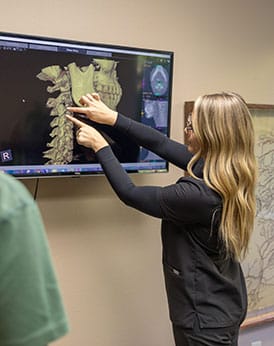
By the time people reach this question, they usually feel a cautious mix of hope and skepticism. We understand both, and we want to describe what upper cervical care actually looks like so there are no surprises. As an upper cervical chiropractor in San Diego CA, the approach we use is precise and measurement-guided. Rather than guessing, we start by carefully assessing how the upper neck is positioned and how your body has compensated since your injury, using specific imaging and analysis to guide everything that follows.
When a correction is made, it is gentle and specific — there is no forceful twisting or cracking of the neck. The goal is not to chase the dizziness directly, but to help the upper neck return toward its normal position so the spine no longer has to compensate as hard. As that structural foundation steadies, many people searching for vertigo relief in San Diego find that their balance system gets clearer, more reliable information to work with, and the dizziness often begins to ease. We are always honest that this is a process and that bodies heal on their own timelines. Some people notice changes early, while for others it unfolds more gradually.
What we can offer is a careful look at something that may have been overlooked, and a team that takes your experience seriously. If standard care has ruled out the dangerous causes but left the dizziness unexplained, this is often the missing piece worth exploring.
You Knew Something Changed After That Accident — Schedule Your Consultation at Upper Cervical Chiropractic San Diego
If your vertigo after a car accident has left you being told you are fine for months — all while you quietly rearrange your life around the dizziness — we want you to know that we hear you. We have sat with many San Diegans who stopped driving the coast highway, stopped coaching their kid’s weekend games at the park, or started declining invitations simply because they never knew when the room would tilt. Those are not small losses. They are the ordinary moments that make up a life, and you should not have to keep giving them away.
You do not need to have all the answers before you reach out. You do not need a referral or a thick stack of records, just your story and your willingness to take one next step. As the upper cervical chiropractor in San Diego CA that your neighbors turn to for this kind of question, we will listen to your full history, take a careful structural look at the upper neck, and tell you honestly whether upper cervical care is likely to help. If it is not the right fit, we will say so.
The dizziness that started after your accident has already taken enough good days. If you have been searching for vertigo relief in San Diego, let us find out together whether there is a reason no one has looked at yet. Call us or book online to schedule your consultation, so you can get back to the San Diego life that has been waiting for you.
Frequently Asked Questions
How long after a car accident can vertigo start? Vertigo can begin right away, but it commonly shows up days, weeks, or even a couple of months after the impact. The delay often happens as the body’s compensation pattern settles in and the balance system gradually struggles to keep up. A later start does not mean the accident is unrelated.
Is upper cervical care safe if I had a head injury or concussion? In most cases, yes. For people dealing with vertigo after a head injury, upper cervical care uses gentle, specific, low-force corrections rather than forceful manipulation, which many find reassuring. We always review your history first and will tell you honestly if we have any concerns or feel another step should come first.
Why does my dizziness get worse when I lie down or turn my head quickly? Position changes ask your balance system to recalibrate quickly, and when the upper neck is sending inconsistent signals, that recalibration can briefly go haywire. Lying down, rolling over, or turning your head fast are common triggers for this kind of cervicogenic dizziness. It is one of the patterns we look for when we assess the neck.
I fell years ago and never thought much of it — could it really be connected to my vertigo now? It can be, and you are far from alone in being surprised by that. An old fall or injury can set up a compensation pattern your body quietly carries for years, until something finally tips it past the point of hiding the strain. That is why we ask about your full history, not just your most recent accident.
What happens at the first appointment? The first visit is mostly listening and assessing. We want to understand your full story — the accident, the symptoms, what makes them better or worse — and then take a careful, measurement-guided look at how your upper neck is positioned. From there, we walk you through what we found and whether upper cervical care is likely to help.
Can I do this alongside what my medical doctor has recommended? Yes. We see upper cervical care as complementary to your medical care, not a replacement for it. Many people continue working with their physician while we focus on the structural piece, and we are always glad for everyone to be working toward the same goal.
Will the visit make me feel more dizzy? Most people find that it does not. The corrections are gentle and specific rather than forceful, and we move at a pace that respects how sensitive your balance can be right now. If anything feels off, we want you to tell us so we can adjust.
Do I need my accident records or imaging to come in? It helps if you have them, but it is not required. If you have scans or notes from after your accident, feel free to bring them, since they add useful context. If you do not, your story and our own assessment give us plenty to start with.
To schedule a consultation with Upper Cervical Chiropractic San Diego, call 858-434-5926 or just click the button below.

If you are outside of the local area you can find an Upper Cervical Doctor near you at www.uppercervicalawareness.com.
About the Author